Showing posts with label War of 1812. Show all posts

Friday, 24 May 2019

A Visit to the Hamilton & Scourge National Historic Site


In a park on the banks of Lake Ontario is a memorial to two U.S. schooners, the Hamilton and Scourge, which sunk during a sudden gale during the night of August 8, 1813. The Hamilton and Scourge National Historic Site sits on Hamilton Beach in Confederation Beach Park in Hamilton.

The schooners were part of a larger American fleet which had been in a cat and mouse game with the British fleet. The loss by either fleet would give the other total control over Lake Ontario and likely total victory in the War of 1812. Both fleet commanders, James Yeo for the British and Issac Chauncy for the U.S., were aware of the consequences and both were cautious in engaging the other without complete control of the wind. It was the wind, though, which did the Hamilton and Scourge in.


Just off the shores of this site is where the two ships went down when a fierce storm struck the fleet. The ships now lie 90 metres (300 ft) below the surface and 450 metres apart (1500 ft).


72 men were on board when the ships went down. 53 of them died. Many years later, Ned Myers, a volunteer sailor aboard the Scourge, told his story to James Fenimore Cooper, author of Last of the Mohicans, who reprinted it in his story, A Life Before The Mast. It's a little long to reprint here but is only a few minutes of very worthwhile, terrifying reading.

In the park, there are memorial tombstones for each of those who lost their life. Crew members of the Scourge are in the area to the left of the flags, those of the Hamilton on the right.


It's a wonderful tribute to those who lost their life in such a terrible time. If you're walking the trail through the park, please take a moment to visit.

Tuesday, 27 February 2018

Douglas Coupland's Monument to the War of 1812


On the northwest corner of Lakeshore Blvd and Bathurst St. stands the Monument to the War of 1812 which was unveiled on November 3, 2008. I have written about it before but had much poorer quality photos.


The monument was done by Douglas Coupland, who is not only an artist, but a writer too with many books in publication. I have read a few and think he is brilliant. It was commissioned by condo developer Malibu Investments Inc. I'm glad to see a developer spend some of its money to highlight the history of a neighbourhood and, in this case, a city and a country.

Just north of the monument a major battle was fought on April 27, 1813, when between 1,600 to 1,800 American soldiers invaded Toronto (then York) in an amphibious attack. The attack is explained in detail in a chapter of my book, Defending the Inland Shores, available at Amazon and Indigo.

In an interview, Coupland said this of his work, "I wanted to create something that was just a quick haiku moment for people driving by or walking by to think about the War of 1812," said Coupland. "But once I began getting involved in the project and doing research, I began noticing that the Americans are now starting to change history and they're saying, 'Well actually we won that,' or, 'Actually, we didn't lose' or whatever.

"So it's a war monument but it's also an incitement for people to remember what's going on in the present as well as the past."

The standing soldier is gold and represents a soldier from the 1813 Royal Newfoundland Regiment, who fought valiantly in the attack. The other is painted silver and is an American soldier from the 16th U.S. Infantry Regiment.


The War of 1812 was an important part of Canadian history and I'm glad to see that we are still committed to remembering those who stood their ground to defend our country.

Monday, 1 August 2016

Simcoe Day at Fort York


This afternoon, Teena and I walked over to Fort York for Simcoe Day activities. Ontario cities and towns have today off as part of their Civic Day holiday weekend. In 1968 Toronto named this weekend after John Graves Simcoe, who was the founder of Toronto. Simcoe also ended slavery in the Canada's, although with some limitations in 1793.

Here is a view looking eastward towards the fort and the city behind it from the military graveyard.


This is a lookout behind the new Fort York visitor centre where there is an excellent view of the fort and city.


The Battle of York was fought from just west of and across the Exhibition grounds.


Old and new. An 1812 cannon in front on newly built condos.


The entrance to the fort with the fort behind.


The Blue Barracks to the left and centre blockhouse.


The magazine which was built in 1814.


The officers' mess.


An officers room. Those boots look quite heavy!


The officers' dining room. Officers seem to have it rather good.


This is the first time I have seen the basement open. Here is the original cooking fireplace from 1815. Down here too are two rooms built in 1837 to store and protect the money held by the Upper Canada Bank in Toronto.


Making cherry pies.


Another city view.


There were dance demonstrations. A short dance lesson followed.


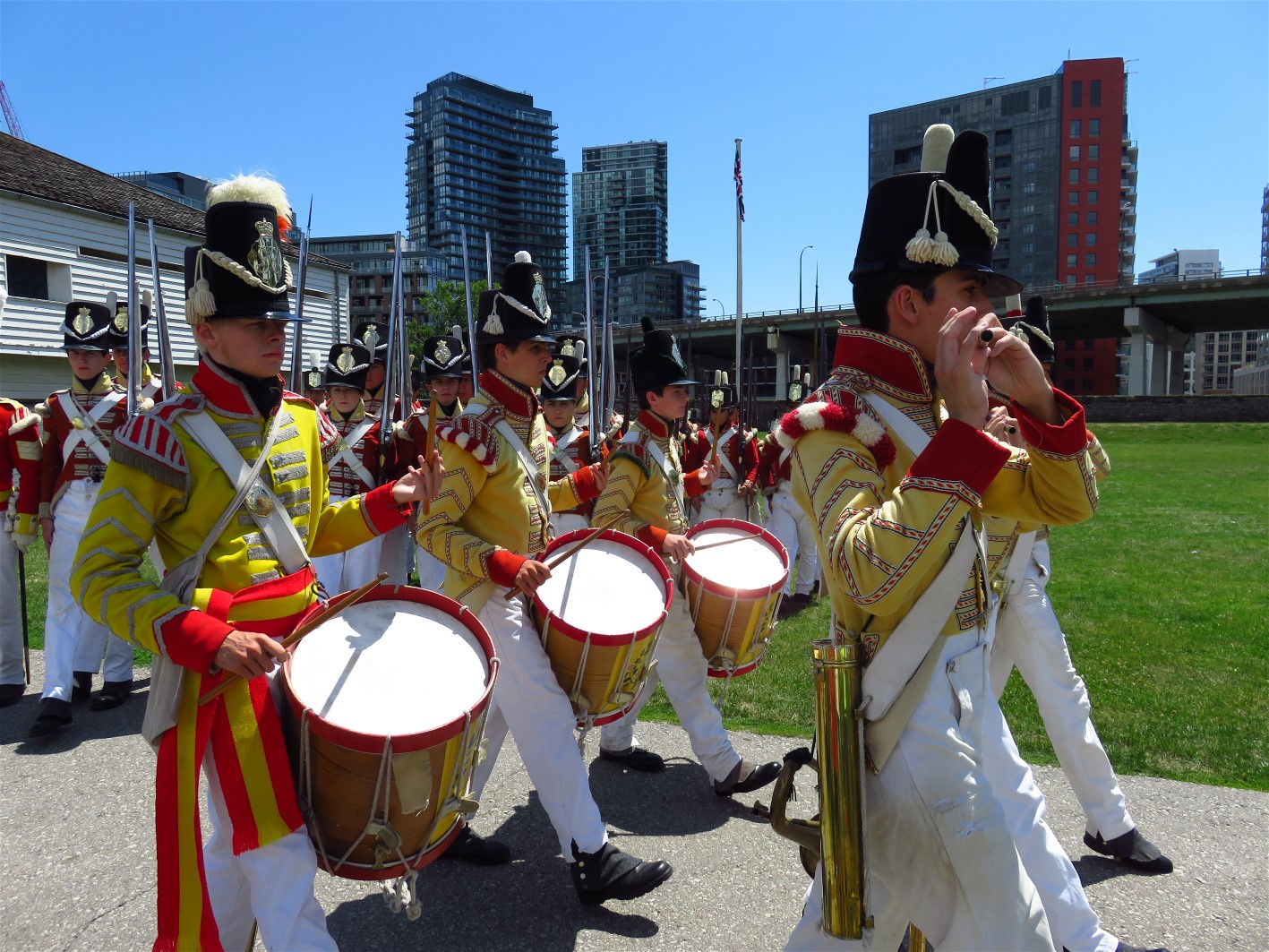
There was a military march and drill presentation. The soldiers were of all ages and they all looked like professional soldiers of the period. Well done! The sound of 50 bayonets being slapped onto the tips of their muskets at the same time, sent shivers down my spine.


 The drum and fife corps.


Here come John Graves Simcoe himself to give a short declaration and inspect the troops.


This was so cool and so loud. They did not fire their muskets at once but do so one, right after another, left to right, all the way done the line ending with a blast from the cannon. It only only took about fifteen seconds to complete.


Afterwards they marched off in formation.


The second magazine (left) and eastern barracks. It was the first time I had been in the brick magazine, which inside show cases the battle of York on both floors.


A cannon protects the fort from the encroaching city.


It was a fun day at the fort. Originally I was going to do something else and Teena suggested we hit the fort. I always have a fun time there and next year I would like to go for Simcoe Day again.

Saturday, 14 November 2015

A Quick Tour of Lundy's Lane Battlefield


Today I am in Niagara Falls, staying overnight as tomorrow I have an early fencing tournament. I arrived at 4pm in Niagara Falls and headed down to the Lundy's Lane Hotel Museum. I arrived around 4:30pm but being off-season, it had closed early. It looks nice. I'll have to come back at a better time.


Still I had the battlefield to tour. With the 200th Commemoration of the war, a gateway with carvings was built at the top of the hill where some of the bloodiest action of the night took place.


A memorial to the midnight battle of Lundy's Lane.


This is the grave site of Laura Secord, who walked 30 km/19 miles to warn the British of an impending surprise American attack on their position. As a result, 50 British soldiers and a group of aboriginal warriors caught and captured 542 American troops.


The battlefield memorial.


This memorial is to General Drummond, who commanded the British troops in victory that night and stood watch over the battlefield the next night awaiting another American attack that never came.


Graves of unknown American soldiers who died in battle that night. As Remembrance Day just passed, American flags are place by their tombstones and somebody had placed an American penny on one of the plaques.


Another view of the memorial.


Here is the museum viewed from the battlefield. I wish I had more time but the sun set fast. I'd like to come back another time to tour the battlefield and graveyard, and tour the museum. Hopefully next year.